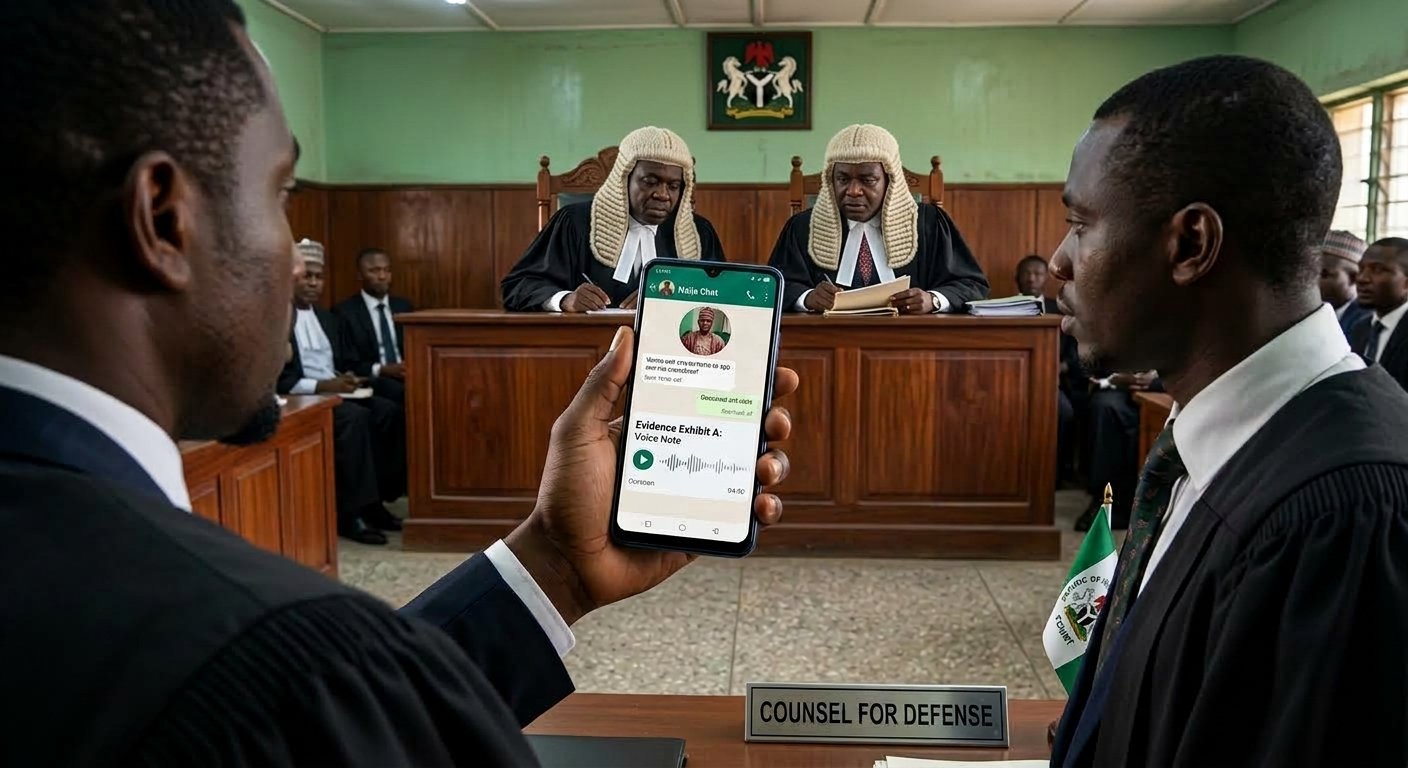
SCREENSHOTS, VOICE NOTES AND RECORDINGS: CAN THEY BE USED AS EVIDENCE IN COURT?


You have a WhatsApp conversation with someone who owes you money. You have the voice note where they promised to pay.
You also have a screenshot of the transaction receipt. You even have a recording of a conversation in which they admitted what happened. Then the issue gets serious, and you decide to take him to court, after all you can ‘prove’ your case. Now, you are beginning to ask yourself, will the court accept all these ‘evidence’ that I have?
Well, the short answer is that electronic records can be used as evidence in Nigerian courts. But having a screenshot or voice recording is not the same thing as proving your case. The court will still be concerned with questions such as relevance, authenticity, admissibility and the reliability of the material being presented.
In practical terms, a screenshot of a WhatsApp chat, an email, an Instagram message or a bank transaction alert may help prove what was communicated or what happened. However, the screenshot must still satisfy the applicable rules of evidence.
A screenshot, voice note or recording does not automatically establish who created the message, whether the account belongs to the person being accused, whether the conversation is complete or whether the image has been altered.
The court may therefore need evidence connecting the screenshot to its source and showing that it is a reliable representation of the original electronic record.
Under Nigerian law, Section 84 of the Evidence Act 2011 provides the framework for the admissibility of statements contained in computer generated documents in Nigeria.
The Evidence (Amendment) Act 2023 also introduced provisions dealing with electronic records and modernised the treatment of electronic evidence. Questions on where the screenshots, voice notes and audio recordings came from and why it should be trusted, who made the recording, whose voice, picture or chats is on it, whether the recording or picture is genuine and complete, then whether the content is related to the dispute, the circumstances in which the recordings or screenshots were obtained, etc. are all relevant to whether they can serve as evidence or not.
By law, the fact that a recording exists does not automatically answer the above questions that need to be proved to the court.
A party seeking to rely on electronic evidence must be prepared to establish its authenticity and satisfy the applicable admissibility requirements, based on the Evidence Act.
The court may need to consider whether the message really came from the defendant, whether the details in it is connected to the defendant and whether the screenshot accurately reflects the original conversation. The person presenting the evidence will have to explain how it was obtained and preserved. Depending on the nature of the evidence, additional testimony or a certificate may be required.
The Supreme Court in Omisore v Aregbesola (2015) LPELR-24803(SC) in its decision on the case which relates to documents downloaded from the INEC website tendered in evidence considered the admissibility of electronically generated documents under Section 84 of the Evidence Act. The court’s decision was that a party who wants to rely on a recording should be prepared to explain whether it is complete, whether any changes were made and whether the recording accurately represents the relevant conversation in dispute.
Electronic evidence therefore has some important guidelines on its use in court as evidence, which are:
- Keep the original
- Keep the conversation complete
- Avoid unnecessary editing
- Record how the evidence was obtained
- Do not delete the device
- Seek legal advice early A lawyer can assess the evidence, identify the relevant legal requirements and advise on the proper way to preserve and present it.